Kovalyov Confronts His Nose
The NoseKovalyov Confronts His Nose is the scene in which Platon Kovaloff meets his missing nose in public and discovers that it has assumed a social identity superior to his own. His attempt to claim it as part of his body meets a rebuff framed in the language of official rank: the nose insists that it is an independent person in a different department. The encounter makes the story’s bodily absurdity legible as a struggle over status, recognition, and the power of titles to govern ordinary relations.
Background and Stakes
The confrontation draws force from Kovaloff’s established investment in rank. Formerly a committee-man in the Caucasus, he cannot forget that position and prefers to call himself “Major,” a title he uses to magnify his importance. He walks daily on the Neffsky Avenue, keeps his collar notably clean and stiff, and wears seals bearing armorial devices or the days of the week. He has come to St Petersburg hoping for an appointment appropriate to his rank—ideally vice-governor, though he would accept a bailiff’s post—and would consider marriage only to a woman bringing a dowry of two hundred thousand roubles.
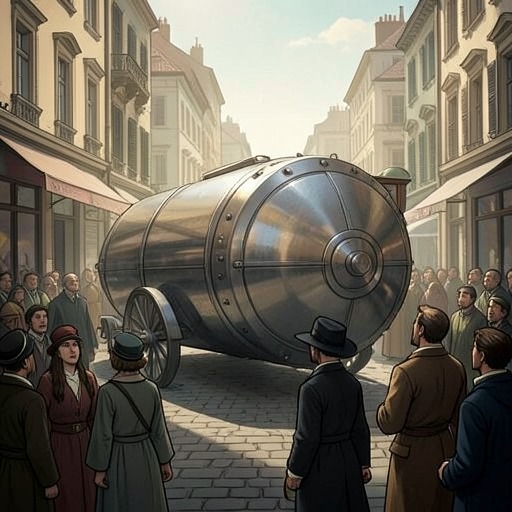
These ambitions explain why the nose’s appearance is more than a physical impossibility for him. Kovaloff’s missing nose threatens the public identity on which his employment hopes and social life depend. In the scene preceding their direct exchange, he sees the nose leave a carriage in a gold-embroidered uniform, with a stiff high collar, chamois-leather trousers, a sword, and a plumed hat marking it as a state councillor. The nose is making duty-calls. Its costume gives it a visible rank, and Kovaloff reads that rank as an obstacle even before he can address it: the uniform seems to place the runaway part of his own body above him in the social order.
The Encounter
Kovaloff follows the carriage to the Grand Bazar of Moscow and eventually spots the nose standing before a shop, half-buried in its stiff collar and attentively inspecting the displayed wares. He is so agitated that he struggles to decide what to do. Rather than immediately seize it, he coughs discreetly nearby; the nose pays him no attention. Kovaloff then approaches with the respectful address “Honourable sir,” and tries to explain that the nose belongs where it came from and that its sudden appearance elsewhere is extraordinary.
The nose demands a clearer explanation. Kovaloff falters, then appeals to his own standing: he is a Major, and it is not fitting for him to go about without a nose. He contrasts himself with an old apple-woman on the Ascension Bridge, who might conduct business without one, and invokes the high-ranking ladies he knows. His case combines bodily dependence with social embarrassment; he needs the nose back not only because it is part of him, but because he is looking for a position and expects to appear among people of consequence.
When Kovaloff finally states the relationship plainly—that the nose is his own—the nose wrinkles its forehead and rejects the claim. It declares itself to be itself and says there can be no close relations between them. As evidence, it points to the buttons on Kovaloff’s uniform, which, it says, show that he belongs to a different department. It then turns away. The argument reverses the ordinary relation between a person and a body part: Kovaloff treats bodily origin as decisive, while the nose treats bureaucratic affiliation and visible insignia as proof of separate identities.
Interruption and Disappearance
The encounter is interrupted by the arrival of an elderly woman in abundant lace, her graceful daughter in a white dress and light straw hat, and a tall lackey with long whiskers. Kovaloff instinctively turns toward the daughter. He adjusts his cambric collar, arranges the seals hanging from his little gold chain, and smiles at her. Her bowed greeting and the glimpse of her chin and rose-tinted cheek briefly draw him into the courtship-minded social world he wants to inhabit.
That impulse collapses when he remembers the blank where his nose should be. He springs back as if scorched, and tears come to his eyes. He turns to denounce the uniformed figure as a pretender who is really his own nose, but the nose has disappeared, presumably to continue its visits. The loss of the opportunity to confront it again compounds the humiliation: Kovaloff has stated his claim, but neither his appeal to bodily ownership nor his attempted appeal to social authority has secured the nose’s return.
Significance
The scene stages status as something performed and recognized through uniforms, titles, insignia, and forms of address. Kovaloff insists on being called Major despite his former committee-man position; the nose’s higher-looking uniform lets it answer his claim from a position of apparent authority. Its reference to departments turns their impossible relationship into a bureaucratic jurisdictional dispute. The absurdity is sharpened by the fact that the nose’s independence is accepted by the social world around it, while its original owner cannot make even a direct personal appeal stick.
The encounter also establishes a pattern that follows Kovaloff beyond the bazaar: he tries to explain his loss through the categories that matter most to him—rank, reputation, and access to elite society. When he seeks an advertisement, he asks to be identified as a committee-man or, preferably, a Major, and worries that acquaintances including Madame Podtotchina might hear of his predicament. The advertising official refuses to publish the notice, fearing that it could compromise the paper and be treated as nonsense; later, the police commissary gives Kovaloff a cold reception and says respectable people do not have their noses stolen. These refusals echo the nose’s dismissal: the institutions he approaches do not restore the bodily relation he regards as self-evident, and instead subject his claim to their own tests of credibility and decorum.
The same conflict remains unresolved when a doctor examines the empty place. After testing Kovaloff’s face with a series of taps and turns, the doctor says the nose cannot be replaced and advises him to remain as he is. Kovaloff protests that he cannot appear in society in such a condition, but the doctor offers no restoration. Against that later failure, the bazaar encounter stands as the moment when the loss acquires a speaking, uniformed opponent. Kovaloff’s nose is no longer merely absent: it has become an independent claimant to identity, and it refuses the relationship on which Kovaloff’s sense of himself depends.